Chinese Pokémon Cards: A Collector’s Guide
Image: Giorgio Trovato on Unsplash
If you collect Pokémon cards in the United States, “Chinese cards” can sound like a question more than a category. Are they official? Are they the same as Japanese cards? Why does one listing say Simplified and another say Traditional? And why does a genuine Chinese card fail the light test you were taught on English cards?
Those are the questions we hear most often at Sleeves & Screens, our shop at 110 W Depot St in downtown Greeneville, Tennessee. We carry Pokémon in English, Japanese, and Chinese, and this is the conversation we would rather have at the counter.
This is a collector’s overview, not a price list, and not a promise that a certain box is in the case today. Inventories change. If you want to see what is on the shelf, visit us in Greeneville or ask before you drive in.
Official Chinese Pokémon cards are a real product line
There is official Pokémon Trading Card Game product printed in Chinese. It is licensed, with its own set lists and packaging. It is not a bootleg of the English or Japanese game.
The word “Chinese” still gets used loosely. People use it for official cards, for counterfeits, and sometimes for any Asian-language card they cannot read. Those are not the same thing. Official Chinese Pokémon cards come in two separate product lines, and they are easy to mix up from a thumbnail.
For a closer look at telling official Chinese cards from fakes, read our guide to real vs. fake Chinese Pokémon cards.
Simplified Chinese and Traditional Chinese are not the same product
Simplified Chinese is the official line for mainland China. On the card, Pokémon is written 宝可梦. This is the newer of the two lines. Official Simplified Chinese TCG product went on sale in mainland China on October 28, 2022. The first wave was 太阳&月亮:横空出世, with presale beginning September 28, 2022.
Traditional Chinese is the official line used in Taiwan, Hong Kong, and Macau. Official pages write Pokémon as 寶可夢. That line is older. The official Traditional Chinese TCG has been on sale since October 2019.

If you remember only one visual check, remember the script. 宝可梦 and 寶可夢 are not a styling choice. They tell you which product line you are holding. A Traditional Chinese card is not a Simplified Chinese card with different typography. It is a different product from a different regional line.
When you are buying, selling, or submitting a card for grading, that distinction comes first. Graders often record Simplified Chinese Gem Packs under a code such as CBB1, and some Traditional Chinese sets under marks that look like the Japanese ones, such as SV8. Those Latin codes are useful in a database. Official Chinese product pages usually use the product’s Chinese name, so a listing code is not the only way to identify a card.
Official Simplified Chinese holos also have a raised Pokémon logo in the lower left, a finish used on that line. If you are comparing print details, do it against a genuine Simplified Chinese card, not an English one.
Gem Packs are a Simplified Chinese series of their own
Gem Packs (宝石包) are an official Simplified Chinese series, not a Traditional Chinese product and not a Chinese reprint of an English booster.
The official name for the first volume is Pokémon 宝石包 VOL.1, or 宝石包第一弹. It went on sale on January 17, 2025, as official Simplified Chinese product entered the Scarlet & Violet (朱&紫) era. Each pack contains four foil cards, with rarity marks that differ from regular Simplified Chinese boosters: three cards at ● or ◆, and one at ★, ★★, or ★★★.
The official preview highlights Paldea starters such as Sprigatito, Fuecoco, and Quaxly, plus trainer-and-Pokémon art from the animated series. The set also includes Captain Pikachu, which graders record under the set name CBB1 C-GEM PACK VOL 1. That label is useful on a graded card. It is not a substitute for checking the official product name and the script on the card itself.
Treat Gem Packs as their own series. If you need exact current contents, check the official information for that volume. Do not borrow English or Japanese booster math.
How Chinese cards differ from Japanese and English
English, Japanese, and the two Chinese lines are all official, and they are not interchangeable printings.
Japanese and official Chinese cards come from different factories, with different print processes, than English cards. English Pokémon cards are printed in the United States and Europe. Japanese cards are printed in Japan, and modern official Chinese cards are made in Japan as well. Simplified Chinese booster boxes and shipping cartons are marked “MADE IN JAPAN,” and Traditional Chinese product sold in Taiwan lists Japan as its country of origin. The Pokémon Company says a card’s country of origin is always shown on the product wrapping, so check the packaging on anything sealed. Card stock, texture, color, and edges are not the same.
That is why any comparison has to be against a genuine card of the same language. A genuine Chinese card held next to a genuine English card will look and feel different. That difference is normal. It is not, by itself, evidence that the Chinese card is fake.
Never apply English-card tests to Chinese cards.
The light test is the clearest example. The test many collectors learned on English cards does not work the same way here. From our own handling at the shop, genuine Chinese and Japanese cards fail that English light test: more light can pass through the stock than you would expect from a genuine English card. If you hold a Chinese card up to a light and compare it to an English card, you will get a misleading result. Compare it only to a genuine card of the same language.
The same is true of the core. English cards have a black core. From what we have seen at the shop, genuine Chinese and Japanese cards have a blue core, which you would see if a card were torn. Do not rip a card to check it. The point is simply this: a blue core on a Chinese or Japanese card is what genuine stock looks like, not a sign that something is wrong, and a missing black line is not a fail.
If you are trying to sort a real Chinese card from a counterfeit, start with the right language line, compare it to a genuine card from that same line, and use the checks in our real vs. fake Chinese Pokémon cards guide. Do not start with an English-card shortcut.
Sets, timing, and artwork also differ across languages. Japanese, English, Simplified Chinese, and Traditional Chinese do not always release the same cards at the same time, or at all. If you are chasing a specific card, confirm the language and the product name or set mark, not just the Pokémon and the pose.
Pack contents and rarity structures can differ too. The official Gem Pack announcement is a clean example: four foil cards, with a rarity mix the official site distinguishes from regular booster packs. We will not invent pull rates or copy an English odds table onto a Chinese product.
Grading Chinese Pokémon cards
PSA and CGC both grade official Chinese Pokémon cards. That includes Simplified Chinese Gem Pack Vol. 1 cards, which PSA lists as CBB1 C-GEM PACK VOL 1, and Traditional Chinese cards from sets such as SV8.
Label the language and the set correctly when you submit. “Chinese” is not enough. Simplified and Traditional are different lines, and the product name or set mark should match what is actually on the card.
Protect the card the way you would protect any card you care about. A penny sleeve and a rigid holder still prevent most of the accidents we see, and we keep sleeves, top loaders, and other supplies on hand at our shop in downtown Greeneville.
Policies can change. If you are about to mail a card in, check the grader’s current rules for that language and product.
How to start, and how to visit
You do not need a sealed case on day one. Decide which line you actually want — Simplified, Traditional, or both, kept separate in your notes — then pick a product you can identify by its official name or set mark.
Hold the cards next to a genuine card of the same language. The differences from English stock are easier to remember in your hands than in a screenshot.
If you are in or near East Tennessee: Sleeves & Screens is at 110 W Depot St in downtown Greeneville. We are a trading card shop and gaming lounge, and Chinese Pokémon cards are part of what we carry, not a one-time curiosity. Hours are Wednesday and Thursday 12 to 8 p.m., Friday and Saturday 2 to 10 p.m., and Sunday 2 to 8 p.m. Closed Monday and Tuesday.
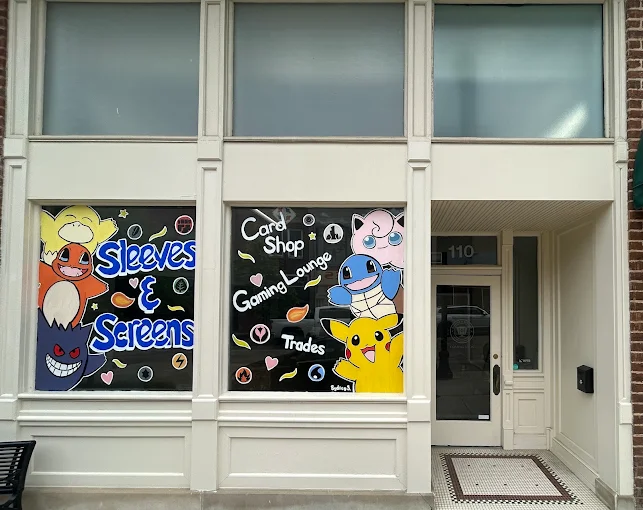
Get in touch if you want to ask about something specific before you drive over, or come by and look at the case. We also host gaming birthday parties in the lounge if you are planning a visit around a celebration.
For a shorter shop-side overview, use the Chinese Pokémon cards page.
Frequently asked questions
Yes. Official Simplified Chinese and Traditional Chinese Pokémon cards are real product lines, not unofficial reprints. They are not the same as Japanese or English cards, and Simplified and Traditional are not the same line as each other.
They are two official lines. Simplified cards use 宝可梦, and Traditional cards use 寶可夢. Identify a product by its official name or set mark, and keep the two lines separate in your notes.
English Pokémon cards are printed in the United States and Europe. Japanese cards are printed in Japan, and modern official Chinese cards are made in Japan as well. Simplified Chinese booster boxes and shipping cartons are marked “MADE IN JAPAN,” and Traditional Chinese product sold in Taiwan lists Japan as its country of origin. The Pokémon Company says a card’s country of origin is always shown on the product wrapping, so check the packaging on anything sealed.
No. Compare a Chinese card only to a genuine card of the same language. The English light test can mislead you on genuine Chinese and Japanese stock, and a blue core is what genuine Chinese and Japanese cards look like, not a fail. Do not rip a card to check it.
We can check and authenticate cards, but we do not grade them. If you want a grade, that is a submission you make to a grading company yourself. We are not a grading service.
Yes. PSA and CGC both grade official Chinese Pokémon cards, including Simplified and Traditional lines. Label the language and the set correctly when you submit, and check the grader’s current rules before you mail anything.
Yes. Sleeves & Screens at 110 W Depot St carries official Chinese Pokémon cards as part of what we have in the shop. Hours are Wednesday and Thursday 12 to 8 p.m., Friday and Saturday 2 to 10 p.m., and Sunday 2 to 8 p.m., closed Monday and Tuesday. Get in touch if you want to ask about something specific before you visit.